Showing posts with label Minto. Show all posts

Thursday, February 5, 2015

A Quite Remarkable Man - the Life of Patrick Brydone and His Family (1736-1818)


This is a review of A Quite Remarkable Man - the Life of Patrick Brydone and His Family (1736-1818)’ by John Evans. Hardback. 384 pp. Published by Amberley Publishing, Gloucestershire, England at £20 (now £18). ISBN 978 1 4456 3890 4.


Patrick Brydone was born at Coldingham on 5 January 1736 to Rev Robert Brydone and Elizabeth Dysart, married Mary Robertson on 4 April 1785 and died 19 June 1818. 

Sir Walter Scott described him as our pilgrim and as "My venerable friend". 

He experimented with electric shock therapy on willing patients; as an army officer, he saw action in France, Portugal and Spain during the Seven Years' War; a tutor in Europe to William Beckford, owner of a large Jamaican sugar estate; author of A Tour through Sicily and Malta - 6,750 copies sold in under 4 years; visited France, Switzerland, Bavaria, Prussia and several other German territories, Austria, Italy, Malta, Hungary, Slovakia, Poland, Russia and became comptroller-general of the London Stamp Office. 

He was obviously a scientist, explorer and a diplomat, so he clearly was a remarkable man. 

There's lots of interesting detail about Italy and Russia but rather less about other countries. Everywhere he seems to have met important people, however there are also anecdotes about peasants and more mundane events. I was interested to learn that miners at a copper and silver mine in Spania Dolina (now in Slovakia) in April 1776 received 12 kreuzers  (about 2½p) for an 8 hour day.

His daughter, Mary, married the Hon. Gilbert Elliot, eldest son of the first Baron Minto, the other 2 daughters married an admiral and a minister. There's some bits about life in the Scottish Borders and other parts of Scotland.  The notes to the book have more detail, there's a bibliography, and an index, mainly of people.

It took me a long time to read this book because, at 384 pages, it is a very long book and rather an academic book. Unlike most academic tomes, it is thoroughly interesting, lots of anecdotes about the celebrities of the day, pastiches about life in all the countries he visited, and helped me to understand events in Britain and Europe during the 17th century. There are lots of illustrations, too.

Today, we're quite used to people going off on holiday all over the world but that wasn't common except for the wealthy in the 18th century. Patrick Brydone not only visited more than 15 countries by travelling thousands of miles in horse-drawn carriages but found time to shape government policy and write about some of his travels.

As I hope the above shows, this book is well worth reading and if I had to find a criticism, it is that I would have liked a sort of "dramatis personae" so that I be reminded at a glance who somebody was when I encountered the name later on in the book. Not only was this book very interesting but it's inspired me to read Brydone's book 'A Tour through Sicily and Malta' which I've discovered is free on the web.


Thursday, September 11, 2014

Review of Hawick Through Time by Alastair Redpath

Hawick Through Time book
96 pp. Illus. ISBN 978-1-4456-3915-4. Amberley Publishing,  2014. £14.99 plus post and packing. Available from Amberley Publishing, The Hill, Stroud, Gloucestershire, GL5 4EP, England.

The book has nicely illustrated card covers. It begins with an introduction to the history of Hawick of almost 2 pages. The following 93 pages comprise clear 'then and now' photographs accompanied by explanatory text, mainly of places in Hawick. There are 8 pages to do with the station and the railway with a fine photograph of the steam engine, Lanarkshire, on its way to Edinburgh in 1959. There are a few pages covering sites outside Hawick, for example Minto House, Denholm, Cavers, and Stobs Camp, the army training ground in both World Wars and a camp for German prisoners-of-war in World War I.

I wouldn't claim to know much about Hawick but I've learnt a lot about Hawick, its buildings and the surrounding countryside from reading the book.

The only drawback is that the author, Alastair Redpath, hasn't included a map of Hawick, so unless you know Hawick well, it will be difficult to understand the lie of the land. I think the book would sell much better with a map and appeal to a much larger audience.

Even so, I thoroughly recommend it and it's suitable for young and old alike. I think it should especially appeal to parents who wish to encourage their children to read. It would make a nice Christmas gift, too.

If you're not from Hawick, or you haven't been there for a long time, you can see useful maps of Hawick on the National Library's website, for example, John Wood's map of Hawick, 1824, or the 1857-58 Large Scale Town Plan of Hawick. For a scrollable Ordnance Survey map of Hawick and the surrounding countryside, see our Hawick parish page.

Hawick Through Time is currently on offer through the publisher at £13.49 including UK post and packing.

Friday, September 14, 2012

The Bengal Obituary Available Online

'The Bengal Obituary, or a Record to Perpetuate the Memory of Departed Worth, Being a Compilation of Tablets and Monumental Inscriptions from Various Parts of the Bengal and Agra Presidencies. To Which Is Added Biographical Sketches and Memoirs of Such As Have Pre-Eminently Distinguished Themselves in the History of British India, since the Formation of European Settlement to the Present Time'
is the title of a book that was published in 1848 for Holmes & Co (a firm of undertakers and monumental sculptors in Calcutta) and is over 400 pages long and contains over 5,000 transcriptions of (mainly) Europeans’ gravestones with brief biographies of 130 people who played notable roles in the colonial history of Bengal.

Most of the gravestones are for officials of the East India Company, soldiers, sailors or their families.

One of the notables was Gilbert Elliot, first Earl Minto (1751-1814), Governor General of India from 1807 to 1813.  Although he died in Stevenage, England, a month after his return from India, he was recognised for supporting the addition of a South Gallery to St John’s Church, Calcutta (now Kolkata) in 1811 and for erecting at his own expense a cenotaph at Barrackpore in memory of the officers and men who fell in the conquest of Mauritius and Java in 1811.

For more information see The Bengal Obituary.

Thursday, October 27, 2011

Minto Monumental Inscriptions


Minto Monumental Inscriptions is the 24th volume of Roxburghshire Monumental Inscriptions to be published by us.

The parish of Minto lies to the north of the River Teviot and to the east of Hawick, surrounded by the parishes of Lilliesleaf to the north, Ancrum to the east, Cavers to the south and Wilton to the west. Part of the old parish of Hassendean was transferred to Minto in the 17th century.

Monumental (gravestone) inscriptions are listed for the 249 of the 257 gravestones at the Parish Church, together with those in the old churchyard which were recorded by the Hawick Archaeological Society.

There are 257 gravestones listed in the volume with colour photographs of all.
Names of householders listed in the Hearth Tax of 1694 are included, together with the Militia Lists of 1813 and 1831, which show an interesting mix of occupations within the parish, reflecting the demands of a rural community and an estate.
There are lists of ministers of Hassendean and Minto, and photographs of Minto War Memorial together with the inscriptions.
Surnames, place names and occupations have been indexed and there are plans of both churchyards showing the location of the stones.

The surnames included are:
Ainslie, Aitchison, Aitken, Aitkin, Anderson, Armstrong, Bain, Ballantine, Barbour, Baring, Bayne, Beattie, Bell, Berry, Biggar, Black, Blackie, Blaikie, Blair, Blake, Blythe, Boa, Borthwick, Brack, Briggs, Brokie, Brown, Brunton, Brydon, Buchan, Budgen, Buglass, Bunyan, Burn, Burnet, Burton, Cairns, Campbell, Caskie, Clark, Cockburn, Cook, Cowe, Craig, Cranston, Crawford, Crichton, Dalgleish, Davidson, Davies, Dawson, Deans, Derham, Dickinson, Dickson, Dilnot, Dobson, Dods, Doherty, Donald, Donaldson, Douglas, Drawhill, Dryden, Duguid, Earle, Easton, Eliot, Elliot, Ewart, Fairbairn, Fergusson, Forsyth, Frame, Gage, Galbraith, Galloway, Gardner, Garnet, Gault, Gibson, Glen, Gotterson, Graham, Gray, Greive, Grey, Grieve, Hall, Halliday, Hanbury, Harvey, Heatlie, Helm, Henderson, Hendry, Herkes, Hill, Hislop, Hobbs, Hogg, Hope, Houd, Hughes, Hume, Hymers, Inglis, Irvine, Jackson, Jardine, Jeffrey, Jewell, Kennedy, Ker, Kerr, Kirkland, Korkis, Lambert, Lambie, Landell, Lang, Lariston, Larner, Lascalles, Lawrie, Lawson, Lillico, Livingstone, Logan, Lowrie, Luke, Macdonald, Mack, Mackie, Mackintosh, Mader, Magson, Matthe, Mauchlen, Maxwell, Mcculloch, Mckenzie, Mckerrow, Mclean, Mcvittie, Melrose, Merchant, Middlemiss, Miller, Minto, Montagu-Douglas-Scott, Montgomery, Murray, Naismith, Newington, Nichol, Norman, Notman, Oliver, Olszowka, Pages, Paterson, Patterson, Peden, Plenderleith, Pollock, Purdie, Ramage, Rennie, Renwick, Rich, Ritchie, Ritson, Robertson, Robson, Romanes, Ross, Routledge, Rutherford, Sanderson, Scott, Selby, Shakespeare, Shanks, Sharp, Shiel, Simson, Skeugh, Smail, Smaill, Smith, Somerville, Spiers, Spindie, Sprott, Steel, Steele, Stenhouse, Stewart, Stirling, Stopford, Strachan, Tait, Taylor, Telfer, Temple, Thomson, Troops, Trotter, Turnbul, Turnbull, Tweedie, Waddell, Wale, Wallis, Ward, Watson, Whitaker, White, Whitelaw, Williamson, Wilson, Witherington, Wood, Wyllie, Young.

Search for surnames in which you're interested in our Gravestones Index Search.

The CD is priced at £7 (plus postage). To buy a copy, please contact Mary Thomson on the Contacts page using the contact type 'Order for Publications'.

Our thanks to all Society members, and friends who assisted in the recording and transcribing.

Sunday, June 14, 2009

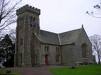
Recording Gravestones at Minto (Ruberslaw Parish Church)

Minto Church
On the last weekend of May, a group of volunteers from the Society met to record the gravestone inscriptions at Minto church, near Denholm.

This was a training event for volunteers new to recording gravestones, and something of an experiment for us.
There were 11 of us working from 10am to 3.30 pm on Saturday, and 8 on Sunday from 1pm to 3.30 pm.

There are 214 gravestones in the churchyard, and we divided ourselves into 5 pairs to record stones. One person entered inscriptions straight into our recording database on a laptop set up next to the church.

It was an unusually hot and very sunny day, which proved slightly difficult for those trying to read faded inscriptions.

Reading inscriptions on the older stones was harder than I expected. We spent a lot of time gently rubbing the weathered lichen covering inscriptions to uncover them, and almost as much time trying to puzzle out the inscriptions. It is greatly tempting to guess what the inscription is, and a huge mistake. One stone took us nearly an hour, as we tried to decipher the text.

Having entered all the inscriptions, they were printed out for us to check, most of which was done on the Sunday. Just to be sure, we checked transcriptions on stones we hadn't recorded; and we found a few mistakes, which we corrected.

All in all, a very enjoyable couple of days, and we did some useful work which will be published soon, another volume in our hugely popular Monumental Inscriptions volumes.

To comment on this article, please click the 'comments' link below.