Thursday, February 27, 2014
Carving History - the Life and Works of Andrew Currie of Darnick - 11 March 2014
The speaker is Bob Johnstone, who has researched his family tree to find the link to Andrew, his great-great-grandfather. Bob will be signing copies of his book.
Admission is £3 to non-members.
Andrew Currie (1812 to 1891) is famous for his stone monuments like Mungo Park in Selkirk, the Ettrick Shepherd at St Mary’s Loch and King Robert the Bruce, erected on the esplanade at Stirling Castle in 1877; as well as other pieces in plaster, wood and marble. He was also an enthusiastic antiquary, an oral historian, and a writer who wrote colourful stories of life in the Borders of the early nineteenth century. Born to a Selkirkshire sheep farmer who fell on hard times, Andrew Currie was obliged against his will to take up a trade. He worked as a millwright until his mid forties, when his health broke. Only then did he become a sculptor, which had long been his dream.
Wednesday, March 28, 2012
More about Witches
A bit later I discovered that there was a Survey of Scottish Witchcraft and having downloaded the database that 42% were from Berwickshire, 31% from Peeblesshire, 20% from Roxburghshire, but only 7% from Selkirkshire.
There's a recent video Scottish Witchhunts from the National Library of Scotland in which Nicola Stratton talks about some of the many recent publications on witchcraft including modern reprints of Malleus Maleficarum which she likens to a Dummies Guide to Witchhunting and James VI's Daemonologie.
She makes some interesting insights and points out that to understand the witchhunts, we need to know about the social history of the period and the legal procedures by which witches could be prosecuted.
Sunday, December 4, 2011
New Additions to Digital Six-inch Maps of Scotland, 1892-1960, at National Library of Scotland
That's just what we've been waiting for. It was revised for Scotland from 1892-1907, and then updated regularly until the 1940s. You can zoom into the detail of the OS six-inch maps using an interactive index map, and search by county, parish and a gazetteer of place names.
You can order digital images and prints.
Use the maps link or the county links below, click the sheet on the map that you want, then at the left select the actual map you want.
Berwickshire
Peeblesshire
Roxburghshire
Selkirkshire
Sunday, October 2, 2011
Survey of Scottish Witchcraft
The database is searchable both by name and place. It doesn’t mention my grandmother's ancestor, the White Witch of Inverness, but if granny was right, she was born about 1790 and thus won’t be in the survey. For those with Microsoft Access on their computers, the database and the accompanying database structure description can be downloaded for further study.
For example, I’ve found that there were almost 300 people resident in the Borders accused of witchcraft of whom 80% were female. 42% were from Berwickshire, 31% from Peeblesshire, 20% from Roxburghshire, and the rest (7%) from Selkirkshire.
Monday, June 27, 2011
Sir Walter Scott, a cowboy of the Wild West ?
The article says that Scott now has a new claim to fame, and that a conference 'Walter Scott: Sheriff And Outlaw, organised by the University of Wyoming' taking place 5th to 9th July in Laramie, Wyoming, USA, will discuss Scott's role as one of the pivotal influences on America's western frontier.
Jeni Calder, who will present a lecture on Scott's frontier legacy, says that Scott's influence on the wild west cannot be over-estimated and examines the comparisons between the wild frontier land of America and that of the Scottish Borders of the late 18th century - where Scott was Sheriff of Selkirkshire from 1799 until 1832.
Friday, June 17, 2011
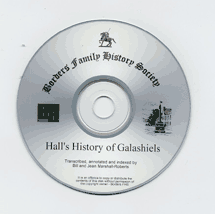
Hall's History of Galashiels
CD price £12.00 plus postage. Weight 70g. See our Publications Sales List to buy.
Wednesday, March 16, 2011
Parishes Ancient & Modern
As you may have seen we’ve now got pages on our web-site for the Counties of Berwick, Peebles and Selkirk. Those for Roxburgh should make an appearance soon. Some of these pages include more detail than others so if you can contribute to one of the pages get in touch with us either via this blog or through the contact form on the web-site (you’ll need to scroll down the page to find it). Please let us know about any mistakes or if you find a broken link.
A few weeks ago I was contacted by the local minister who wondered why Innerleithen and Traquair merited a page each whilst Walkerburn didn’t. For most part the parishes listed are the historic parishes not the current ones. Whilst there's nothing quite as formal as a cut-off date in practice it's those parishes that existed in 1855 the point at which Civil Registration was introduced to Scotland and the cut-off date for the Old Parochial Records held by the General Registrar's Office for Scotland (and available on the Scotland's People web site). Not that we’re totally consistent as Kirkhope and Caddonfoot do have their own page despite being 19th century creations which have now been absorbed by neighbouring parishes. However I did borrow the Church of Scotland Yearbook from the local minister and in time the parish pages will indicate what has happened to the ancient parishes – and where I can find one a link to the church web-site.