
Family Search lists Robert Balmer's birth on 22nd November 1787 and christening, 8 days later, at Eckford, Roxburghshire, Scotland.
According to his Academical lectures and pulpit discourses
which includes a memoir of his life, his father was Thomas Balmer and
his mother, Margaret Biggar and they lived at Ormiston Mains.
Thomas was probably a farmer; he had been offered a farm by the Duke of
Buccleuch but he preferred to be a land-steward, first at Ormiston and
later at Crailinghall. He was a member of the congregation at Morebattle, connected with the General Associate (Antiburgher) Synod.
Margaret was a granddaughter of the James Biggar mentioned in the autobiography of the venerable Boston of Ettrick. She adhered to the congregation at Jedburgh, connected with the Associate (Burgher) Synod. Family Search lists Thomas Balmer and Margaret Biggar's marriage on 6th January 1786.
They had 2 other sons, Walter (probably born 30 January 1790; later emigrated to USA) and James (probably born 14th March 1794) and a daughter, Helen, (probably born 22nd April 1796). The memoir doesn’t mention Stephen (christened 19th October 1788 in the same place as the others) or Nelly (christened 5th August 1792 at Hobkirk).
At the age of 9, Robert went to a school at Crailing
Mill, taught by Richard Scott, later one of the elders of Golden Square
congregation, Berwick. Thomas died about a year later and Mrs Balmer
opened a shop at Eckford-moss. Robert moved to Eckford parish school and
attended Morebattle parish school to learn Latin.
At age 14, he went to Kelso Grammar School, stating during the week with his aunt at Maxwellheugh.
He went to Edinburgh University at the beginning of the session 1802-3.
In the autumn of the year 1806, after undergoing an examination by the Associate Presbytery of Selkirk, he was admitted to the study of Divinity under the Rev. Dr George Lawson, supporting himself by teaching.
He was licensed to preach the Gospel on 4th August 1812. He was offered
posts by congregations in Lochwinnoch, Leslie, Ecclefechan, and Berwick,
and in autumn 1813 picked Berwick (perhaps because his mother and his
brother, James, lived in Berwick).
He said in a letter to a friend “My ordination took place on Wednesday,
the 23rd of last month (March 1814). The person who preached first, and
who ordained (presided at the ordination), was Mr Lee of Horndean, a
most intimate acquaintance, and one of the best men, I believe, in the
Burgher Synod. A friend and relation not less dear, Mr Paterson of
Alnwick, preached after him. Mr Peddie from Edinburgh was present, and
introduced me on the following Sabbath.”
He was clearly prized by his Berwick congregation; the Caledonian Mercury reported:
“on
13th July 1819, an elegant silver cup and ….. a beautiful set of table
plate, value 50 guineas (£52.50) were presented by the principal members
of the Burgher Associate Congregation of Berwick, ….. at the Red Lion
Inn, as a token of the high esteem they entertain for him.”
On 18th July 1826, Robert married Jane Scott, daughter of Alexander Scott of Aberdeen. One of Jane’s sisters was a landlady in Slateford, Edinburgh, her brother, John wrote ‘Visits to Paris’.
No children are mentioned in the memoir.
In 1833, he was appointed Professor of Systematic Theology to the United Secession Church.
Robert’s mother, Margaret Biggar, died in 1839.
In 1840, the University of St Andrews conferred on him the honorary
degree of Doctor in Divinity. He preached in many places including
London, Glasgow and Edinburgh and was an active participant in the
controversy that, ultimately, led to the disruption of the churches.
He died on the morning of Monday, July 1, 1844 after several weeks
with a severe and painful illness and was buried on 9th July. His death
was reported in many newspapers in England and Scotland. Apart from a
volume of sermons in 1819, he published little during his lifetime,
except in newspapers.
There's a photograph of an imposing column and its inscription in Holy Trinity churchyard, Berwick, on the Find A Grave website.
Are you related to one of Robert Balmer's brothers or sisters ?
Showing posts with label Kelso. Show all posts
Showing posts with label Kelso. Show all posts
Tuesday, April 7, 2015


Sunday, March 22, 2015
Come to a talk about John Hamilton Hall (1799-1865) at Kelso on 29 March

Part of the research I did for Berwick 900
last year was about a Coldstream lad, John Hamilton Hall, born in 1799, whose father
was not only a general physician but also a Freeman of the Berwick-upon-Tweed Guild.
Seeing
his name and occupation in the Guild records led me on an interesting and
puzzling hunt for information about his family, his career as an officer in the
East India Company’s Bombay Infantry.
On Sunday, 29th March, at
the Abbey Row Community Centre, The Knowes, Kelso, TD5 7BJ, I’ll be talking
about his life and career, however, just as importantly, I’ll be discussing how
I researched him, some of the problems I found and the difficulties in reading
and understanding the records. Map.
The talk has been widely advertised, including
in Berwick, due to local Berwick interest, so come early to get a good seat.
I
warmly invite you to attend the talk whether you are a member or not. Doors
open at 2pm; the talk begins at 2.30pm.
We'll have a range of family history
publications available to buy, and there’ll be light refreshments (donation
expected) available after the talk. If you have a problem with your family
history, please discuss it with one of our volunteers.
Wednesday, January 28, 2015
Last Freight Train to Kelso - Information Wanted

My interest in Border railways hasn't diminished and I've watched original photographs of locations sell for jaw-dropping prices on an internet auction site. Sadly, these historic shots seem to disappear into a black hole never to appear again.
Recently, there was a negative of Kelso station. The description said it was part of a collection; I suspected that in the normal course of events the usual bidders would win and the collection disappear.
I contacted the vendor and after some to-ing and fro-ing of emails, agreed on a price and I went to pick up the collection. After blethering for a while, he told me to take away a sports bag containing not just the negatives but some 25 reels of ciné film. For all the world, the 'collection' has the hallmarks of a house clearance.
It was, and still is, my intention to make sure that the railway negatives will be available to view once they are scanned and locations identified properly; some 70 of them are easily identified as taken around Kelso station.
I have no facility to watch 8mm ciné, however a friend produced a viewer which was hand-powered. One of the films was, intriguingly, labelled, 'St Boswells – Kelso – Tweedmouth' - a prime candidate for watching. Part of the way through the film were shots of the last freight train to Kelso in 1968. I had had permission to travel on it, and there, on the flickering ciné was a glimpse of me!
Although it was almost 50 years ago, I can recall quite clearly a gent waiting the arrival of the last freight. He had a couple of cameras and I think, perhaps, he was wearing a brown warehousecoat. On speaking to him, he said that he worked at the foundry.
From the locations, many taken between Kelso and Sprouston, and from the subjects of the negatives, I would hazard a guess that he lived and probably worked not far from the station.
However, not only is there 8mm ciné but also 9.5mm ciné. I have only looked at the white lead-in for clues; there are obviously several reels of Kelso and one of a foundry. I would guess a date around late 1960s. I'm hesitant at watching the other reels as I could damage the ciné.
One of the reel containers has “D W K C C” on it could this be DWK and Ciné Club ?
Can you suggest a name for a pretty prolific ciné enthusiast from Kelso and who possibly worked at the foundry? I'd like to make contact with any family members.
By Bruce McCartney
Just to clarify matters, the picture shown above was taken by Bruce and appears here with his permission.
Responses below, please, or via our Contacts page (choosing Contact the Chairman).
Saturday, July 19, 2014
St Boswells Fair/Gypsy Fair Exhibition - First Day (18 July)
This exhibition is in St Boswells Village Hall.
I'm happy to say that we were busy.
Though it wasn't meant to be open in the morning, people drifted in because the doors were open to receive exhibitors, and we were busy all day.
The organisers counted just under 200 visitors, including as we hoped, lots of gypsies.
Lots of interest in John McKale's books and paintings.


The children's table, where there is a competition in 3 age groups to win book tokens, was often crowded.
3 members of the gypsy Royal Family talked to us, and Davina took the family tree on display home to update it.
I met people who had come from south Yorkshire, Berwick, Glasgow, Fife, as well as various places in the Scottish Borders: Eyemouth, Gordon, Kelso, Lauder, Westruther, West Linton as well as St Boswells.
I was also introduced to Mary Hanson (and her husband, Keith) who has done a lot research into the gypsies and into Napoleonic prisoners of war in the Scottish Borders.
Unfortunately, we are limited by table space in the number of items we can display for sale and as luck would have it, there were a number of things we could have sold had we bought them with us.
Lots of the gypsies were interested in the Hawick Heritage Hub's photographs, some wanted copies, others identified family members.
If you come today (1pm to 7pm) or tomorrow (1pm to 4pm), make sure to fill in a feedback form to win a bunch of carved wooden flowers.
I'm happy to say that we were busy.
Though it wasn't meant to be open in the morning, people drifted in because the doors were open to receive exhibitors, and we were busy all day.
The organisers counted just under 200 visitors, including as we hoped, lots of gypsies.
Lots of interest in John McKale's books and paintings.
The children's table, where there is a competition in 3 age groups to win book tokens, was often crowded.
3 members of the gypsy Royal Family talked to us, and Davina took the family tree on display home to update it.
I met people who had come from south Yorkshire, Berwick, Glasgow, Fife, as well as various places in the Scottish Borders: Eyemouth, Gordon, Kelso, Lauder, Westruther, West Linton as well as St Boswells.
I was also introduced to Mary Hanson (and her husband, Keith) who has done a lot research into the gypsies and into Napoleonic prisoners of war in the Scottish Borders.
Unfortunately, we are limited by table space in the number of items we can display for sale and as luck would have it, there were a number of things we could have sold had we bought them with us.
Lots of the gypsies were interested in the Hawick Heritage Hub's photographs, some wanted copies, others identified family members.
If you come today (1pm to 7pm) or tomorrow (1pm to 4pm), make sure to fill in a feedback form to win a bunch of carved wooden flowers.
Monday, April 1, 2013
Charlotte Wintrup's Boots

It reads, in his hand writing:
"This is to certifie that these little boots was the last that my little Dear Charlotte Wintrup wore while hear on this Earth & it is hur Fathers wish they will not be worn by no won while they are as a token of Rememberance of my Dear Little Daughter who died at Walkerburn on the 19th May 1876 Aged 4 years & 2 months, James Wintrup hur loving Father".
The boots moved from place to place across the USA as her family moved. Back in 1978, her father accepted a job in the Middle East and although many of the antiques her father and mother had collected, as well as all their household furniture, were lost in a warehouse fire, Charlotte's boots had been stored with her grandmother and they were spared from the fire !
Charlotte was born in Galashiels. Her father was James Wintrup, son of John Wintrup and Margaret Gray. He was born about 1829 in Kelso and died 20th March 1896 in Galashiels. Charlotte's mother was Charlotte Brown, born in 1832 in Darnick and she passed away in Galashiels on 25th November 1882. According to the census, the family were millworkers in Galashiels. Are you related to those Wintrups ? If you are, please get in touch, either at Old Gala House or via our Contacts page selecting the Contact Type 'Border Telegraph'.
Book now for our Conference on 11th May 2013 in Galashiels, Scotland.
Monday, November 19, 2012
Change to our Programme for Sunday 25th November

The original planned talk on the 'Black Death' has been postponed due to unforeseen circumstances and may be re-scheduled for 2013.
As usual, the doors will open at 2.00pm and the talk starts at 2.30pm.
Admission is free and we’ll have usual sales tables and refreshments after the talk. I hope to see you there. Map.
Saturday, April 28, 2012
Kelso Rosebank Cemetery Book Out of Print
They were large and needed a lot of storage space and were comparatively costly at £21 plus postage. We're not planning a reprint.
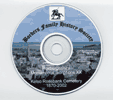
The Kelso Rosebank Cemetery CD (see image) is still available, has the same content as the book, and is a bargain at £10 plus postage. It's also a lot cheaper to post a CD than an A4 book.
It contains all the usual things that we put in our Monumental Inscriptions publications like a Militia list as well as the monumental inscriptions/gravestone inscriptions from the 2454 gravestones in the cemetery except that there's no Hearth Tax list, no War Memorial inscriptions, and no list of kirk ministers. It covers stones installed between 1870 and 2002 in the Rosebank Cemetery, Kelso, Roxburghshire. There is an index to the surnames and you can search the index of surnames.
The other Monumental Inscriptions publication for Kelso, Roxburghshire is Kelso Abbey, Old Churchyard & St Andrew’s CD which also costs £10 plus postage.
This contains details and photographs of 460 monumental (gravestone) inscriptions for Kelso Old Churchyard, Purvis Aisle, Kelso Abbey, and St Andrew’s Episcopal Church and the inscriptions on 199 stones lost in 1979 when the surrounding wall was removed from the churchyard and new paths were laid allowing direct access from the Knowes car park to the town centre.
We’ve also included the inscriptions on the Kelso War Memorial, the war memorials in St Andrew’s Church, St Mary’s Church, and Kelso High School. It includes a list of ministers, the landowners and tenants on the Hearth Tax assessment in the parish of Kelso in 1690, the men on the Militia list from 1797 to 1801, a plan of Kelso dated 1854, a plan of the churchyard and an index to the surnames included in the inscriptions.
Additionally, there’s a list of funerals and dates in Kelso 1798 to 1813. This is particularly useful because many of Kelso’s inhabitants were buried without a marker, visitors to the parish were sometimes buried without their name being known. Several regiments were stationed in the town, together with French Prisoners of War and their burials are recorded here.
See our full range of Monumental Inscriptions publications.
Thursday, March 1, 2012
February 2012 Issue of Borders Family History Society Magazine Just Out

The latest issue of our 44 page Borders Family History Society magazine was posted to members on 27th and 28th February.
Although the first issue of the calendar year was previously in March, the editor has decided that February is more suitable.
This issue contains articles about
- new maps at the National Map Library
- Coldingham monumental inscriptions
- the memoirs of George 'Celery' Taylor
- Borders surnames
- the family of William Oliver (1812 - 1888) and Elizabeth Turnbull (1813 - 1887) who emigrated from Southdean, Roxburghshire to South Australia
- a pair of silver sugar tongs
- Andrew Currie, Border sculptor
- the remaining part of the talk "Granny's Bawbees" about Scottish coinage that I gave on 29th May 2011 (including an illustration of a halfpenny-sized advertising token below issued by John Pringle & Co of Kelso)
- an intriguing story titled "What might have been"
- 17th century Border witchcraft
- Cadwallader Colden
- Gunsgreen House, Eyemouth
Sunday, November 27, 2011
From Kelso to Kalamazoo
I’ve
just returned from our November open meeting in Melrose Michigan
George’s
journal or memoirs came to light as part of a local history project by Eckford
Woman’s Rural Institute. With the help
of an IT literate daughter they were first in published on the web. In 2009 “From Kelso to Kalamazoo Kalamazoo
The
book is full of delightful little vignettes of 19th century life in
rural Scotland Edinburgh Edinburgh
George
Taylor became a market gardener eventually becoming foreman of a Kelso market
garden. He thought about his work carefully
and found that protecting potato plants with straw reduced the instance of
blight at a time that it was ravaging the potato crop in both Ireland and Scotland
In
1855 George Taylor emigrated to the United States
and started a truck farm in Kalamazoo ,
Michigan USA Scotland
Thank
you to Margaret Jeary for a clear and interesting talk.
Our
next meeting is on 26th February 2012 in Melrose
Monday, November 21, 2011
From Kelso to Kalamazoo

At the meeting, Margaret Jeary will tell us about George Taylor, who around the age of 50 left a successful career as a horticulturalist in Kelso to start a new bedding plant business in Kalamazoo (once known as Celery City), Michigan, USA.
He seems to have been a colourful character and he married 4 times.
There's a bit more about him in this description of Margaret Jeary's book, From Kelso to Kalamazoo, but come and hear a lot more on Sunday.
The doors will be open at 2pm, with the talk starting at 2.30pm.
We warmly invite you to attend the talk whether you are a member or not.
There is no admission charge.
We'll have a range of family history publications available to buy.
Refreshments available after the talk (donation appreciated).
If you have a problem with your family history, please discuss it (no charge) with one of our volunteers.
Wednesday, October 26, 2011
October 2011 Issue of Borders Family History Society Magazine

The latest issue of our 44 page magazine was despatched to members on 21st October.
I understand that due to the labour dispute at Canada Post, there is a backlog of mail, so Canadian members may experience additional delays before receiving their October 2011 magazine.
This issue contains articles about
- the successful tracing of the family of a relative of an American lady's late husband, a John Robert Grant who had been born in Galashiels in 1885, and transferring personal papers and photographs to the family
- the Stewarts of Kelso
- a family bible reunited with the family of the original owner, who wrote in it in 1812
- the cholera epidemic of 1849
- rules of intestate succession
- the first part of the talk 'Granny’s Bawbees' about Scottish coinage that I gave on 29th May (including 4 colour illustrations of Scottish and British coins)
- reviews of 4 books
- this summer's work on transcribing gravestones
Tuesday, July 5, 2011
June 2011 Magazine

Lauderdale, a notice about Stirling University Conference - Monuments and Monumentality in Later-Mediaeval and Early Modern Europe, articles on the life of Dr. John Leyden, Maps as Historical Sources, Arrangements for a Victorian Wedding, examples of records at the Hawick Heritage Hub, Bi-gen Blogspot, Kelso Mail Marriage entries between 1808 and 1823, the Black Dwarf (at Manor, Peebleshire), some epitaphs written by Robert Burns; as well as details of new members and their interests.
The magazine was despatched to members on 29th June.
If you haven't received your magazine within a reasonable time, please let us know on the Contacts page as soon as possible, selecting the 'Magazine Non-Arrival' contact type, and specifying your full name, email address and postal address.
Due to the labour dispute at Canada Post, we understand there is a backlog of mail, so Canadian members may experience additional delays before receiving their June 2011 magazine.
Friday, June 17, 2011
Roxburghshire Monumental Inscriptions - No 20: Kelso Rosebank Cemetery
Contains a militia list, as well as the monumental inscriptions/gravestone inscriptions from the 2454 gravestones in the cemetery. There is an index to the surnames. Covers stones installed between 1870 and 2002.
Available as a CD or an A4 format book, each has the same content. 2454 gravestones. Book 202 pp including index and illustrations. ISBN 1 874232 07 0.
CD price £10.00 plus postage. Weight 70g.
Book price £21.00 plus postage. Weight 620g.
See our Publications Sales List to buy.
Sunday, April 3, 2011
Revised and Improved Edition of Kelso Abbey, Old Churchyard, St Andrews Monumental Inscriptions
The late Audrey Mitchell wrote that Kelso was described by Sir Walter Scott, who attended school there from 1783, as 'the most beautiful, if not the most romantic, village in Scotland'. Early Kelso grew in two distinct halves. Easter Kelso formed in the vicinity of the Abbey, which was founded in 1128 by King David I, and retained its importance as an ecclesiastical burgh until the late 16th Century, by which time the fabric of Kelso Abbey had been largely destroyed and the monks dispersed. Wester Kelso, also known as Faircross, was obliterated in the late 18th Century when the Duke of Roxburgh formed entrance gates to Floors Castle and a fruit garden on the ground occupied by the village. Legend states that plague victims of the 17th century were buried in a mass grave at the Knowes, near the Abbey and bones were found in this area during archaeological excavations. Kelso was primarily a market town and had no large-scale industry until the 20th century.
We've extensively revised and improved this volume (previously known just as Kelso) and it's available on CD.
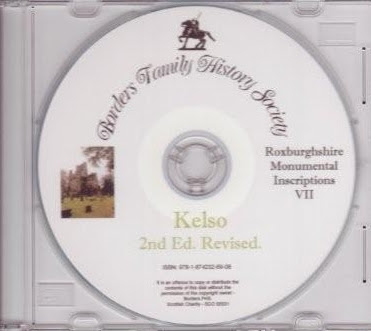 It comprises the details and photographs of 460 monumental (gravestone) inscriptions for the Old Churchyard, Purvis Aisle, Kelso Abbey, and St Andrew's Episcopal Church and the inscriptions on 199 stones lost in 1979 when the surrounding wall was removed from the churchyard and new paths were laid allowing direct access from the Knowes car park to the town centre.
We've also included the inscriptions on the Kelso War Memorial, the war memorials in St Andrew's Church, St Mary’s Church, and Kelso High School. It includes a list of ministers, the landowners and tenants on the Hearth Tax assessment in the parish of Kelso in 1690, the men on the Militia list from 1797 to 1801, a plan of Kelso dated 1854.
There is a plan of the churchyard and additionally, there's a list of funerals and dates in Kelso 1798 to 1813. This is particularly useful because many of Kelso's inhabitants were buried without a marker, visitors to the parish were sometimes buried without their name being known. Several regiments were stationed in the town, together with French Prisoners of War and their burials are recorded here, as well as an index to the surnames included in the inscriptions.
There are more than 500 different surnames included in the inscriptions on the gravestones, and they are: Adams, Affleck, Aimer, Aimers, Ainslie, Aitchison, Aitken, Aitkinson, Aldcorn, Alexander, Allan, Amey, Anderson, Andrew, Archbald, Armstrong, Arniel, Arnold, Auchterlonie, Awburn, Bailey, Baird, Balfour, Ballantyne, Balmer, Baptie, Barclay, Barker, Barstow, Bell, Bennet, Best, Bettie, Biggar, Bishop, Biss, Black, Blackhall, Blackie, Blair, Blaw, Blenkinsop, Blyth, Blythe, Boazman, Bolton, Bonar, Bonthorn, Boole, Borthwick, Boston, Boswell, Bothwick, Bowie, Bowman, Boyd, Broad, Bromfield, Brooks, Broomfield, Brotherston, Brown, Brownlee, Brownlees, Bruce, Brunlees, Buchan, Buchell, Buckham, Buddo, Bulman, Burn, Burnet, Burnett, Burns, Burrows, Cairns, Carfrae, Carss, Cassy, Chalmers, Charlewood, Chisholm, Clark, Cochrane, Cockburn, Cook, Cooper, Cossar, Craig, Cranston, Cranstone, Craw, Crawford, Crease, Crichton, Crosbie, Culbertson, Cunningham, Cunninghame, Curle, Curle, Curle, Curll, Curry, Dakin, Dalgleish, Dames, Darling, Davidson, Dawson, De Borgh, Deans, Dennistoun, Dewar, Dickie, Dickinson, Dickman, Dickson, Died, Dippie, Dixon, Dobson, Dodds, Dods, Douglas, Dryden, Drysdal, Drysdale, Dudgeon, Duke, Duncan, Dunlop, Dunn, Dunnings, Dunsmure, Easton, Edmonston, Elliot, Emen, Ewen, Fair, Fairbairn, Falconar, Falconer, Falkner, Fawcit, Fender, Ferguson, Fergusson, Ferne, Fettes, Finch, Fishburn, Fleming, Fletcher, Flighty, Flintoff, Foord, Forbes, Ford, Forrest, Forrett, Forsyth, Frank, Fraser, Frazer, Frier, Fullerton, Fyfe, Gallon, Gaston, Gibb, Gibson, Giles, Gillespie, Gillies, Glaister, Glass, Glendining, Glindinning, Gordon, Gosset, Gow, Graham, Gray, Greenlaw, Grey, Grieve, Grossert, Guthrie, Haig, Haldane, Hall, Halliburton, Hambley, Hambly, Hammond, Happer, Hardie, Hay, Hedley, Henderside, Henderson, Henry, Herbert, Hermiston, Hervey, Hewat, Heweit, Hewitson, Hill, Hillson, Hilson, Hindle, Hindmarsh, Hislop, Hislope, Hogarth, Hogg, Holman, Holme, Holmes, Home, Honeyman, Hood, Hookes, Hooper, Hough, Howlistone, Huggan, Huie, Humble, Hume, Hunter, Hush, Hutchinson, Hymers, Imieison, Innes, Innes Ker, Irvine, Jack, Jackson, Jaffrey, Jameson, Jamieson, Janitson, Jarvie, Jeffrey, Johnson, Johnston, Karr, Kay, Keenan, Keith, Kell, Kennedy, Ker, Kerr, Kerss, Kinghorn, Knox, Kydd, Kyle, Ladlin, Laidlaw, Lamb, Lamont, Lauder, Law, Lawlee, Lawson, Lawton, Leadbetter, Learmont, Learmonth, Learmouth, Leck, Lee, Leech, Leitch, Leyden, Liddell, Lidgate, Lillie, Limmon, Lindores, Lindsay, Linton, Litster, Loasby, Lockie, Logan, Lorimer, Lundie, Lunn., Lyell, Lyle, Lynn, Mcallister, M’cheyne, Mccoln, Mccorquodale, Mccutcheon, Macdonald, Mcdougal, Mackdougall, Mcdougall, Macintosh, Mackintosh, Mcintosh, Mckay, Mackenzie, Mckenzie, Mckinlaw, Mckraket, Maclean, Mcleod, Mabon, Main, Manl, Marjoribanks, Marr, Marsh, Marshall, Marten, Mason, Mathew, Mauchlen, Maule, Maxwell, Meather, Mein, Melrose, Menin, Merrylees, Michie, Mickle, Middlemas, Middlemiss, Middlemist, Millan, Millar, Miller, Mills, Milne, Mitchell, Mitchelson, Moffat, Moir, Mollifof, Moore, Morison, Morrison, Morton, Moscrip, Moubray, Muir, Munro, Murdy, Murray, Needham, Neil, Nelson, Nesbit, Newton, Nicholson, Nicol, Ogden, Oliphant, Oliver, Ord, Ormiston, Ormston, Oswald, Ovens, Paton, Patterson, Pattison, Paul, Pearson, Peat, Penman, Perfect, Pettigrew, Pillans, Pirie, Pitcairn, Pittillo, Plummer, Porteous, Potts, Primrose, Pringle, Proctor, Purves, Purvis, Pyle, Rae, Ramsay, Ranton, Rathie, Rea, Redden, Redpath, Reid, Renton, Renwick, Richardson, Richmond, Rickets, Riddel, Riddell, Ridley, Ridpath, Rintoul, Ritchie, Robertson, Robinson, Robison, Robson, Rogerson, Rolph, Romanes, Romanis, Ronald, Ross, Routledge, Roxburgh, Rule, Russell, Rutherford, Rutherfurd, Ryrie, Sadler, Sanderson, Scott, Sear, Selkirk, Sharp, Shaw, Sheil, Shiel, Shiell, Shirreff, Short, Simpson, Sitwell, Slight, Small, Smith, Somerville, Spark, Spiden, Spottiswoode, Stalker, Steel, Stenhouse, Stephenson, Stevens, Stevenson, Stewart, Stimpson, Stobo, Stodart, Stoddart, Stormonth, Story, Strachan-Audas, Stuart, Sudden, Swan, Swanston, Swinton, Sword, Tait, Tasker, Taylor, Telfer, Telfor, Thompson, Thomson, Thorburn, Tinlin, Tod, Torrie, Train, Tranent, Trotter, Tully, Turnbull, Turner, Tyrode, Valance, Waddle, Waldie, Waleid, Walker, Wallace, Wardlaw, Watson, Watt, Watters, Waugh, Weatherston, Weddell, Weir, Welsh, Wemyss, White, Whitecross, Whitehead, Whitelaw, Whitelock, Whitlock, Whyte, Wight, Wightman, Wild, William, Williamson, Willink, Wilmot, Wilson, Winter, Wood, Woodrow, Wright, Wylie, Young, Yule.
Search the Gravestones Index in the usual way, to see how many stones there are for a surname.
The CD costs £10 plus postage.
To get a copy, please contact Mary Thomson on our Contacts page using the contact type Order for Publications.
We've extensively revised and improved this volume (previously known just as Kelso) and it's available on CD.
 |
| Old Kelso volume (superseded) |

We've also included the inscriptions on the Kelso War Memorial, the war memorials in St Andrew's Church, St Mary’s Church, and Kelso High School. It includes a list of ministers, the landowners and tenants on the Hearth Tax assessment in the parish of Kelso in 1690, the men on the Militia list from 1797 to 1801, a plan of Kelso dated 1854.
There is a plan of the churchyard and additionally, there's a list of funerals and dates in Kelso 1798 to 1813. This is particularly useful because many of Kelso's inhabitants were buried without a marker, visitors to the parish were sometimes buried without their name being known. Several regiments were stationed in the town, together with French Prisoners of War and their burials are recorded here, as well as an index to the surnames included in the inscriptions.
There are more than 500 different surnames included in the inscriptions on the gravestones, and they are: Adams, Affleck, Aimer, Aimers, Ainslie, Aitchison, Aitken, Aitkinson, Aldcorn, Alexander, Allan, Amey, Anderson, Andrew, Archbald, Armstrong, Arniel, Arnold, Auchterlonie, Awburn, Bailey, Baird, Balfour, Ballantyne, Balmer, Baptie, Barclay, Barker, Barstow, Bell, Bennet, Best, Bettie, Biggar, Bishop, Biss, Black, Blackhall, Blackie, Blair, Blaw, Blenkinsop, Blyth, Blythe, Boazman, Bolton, Bonar, Bonthorn, Boole, Borthwick, Boston, Boswell, Bothwick, Bowie, Bowman, Boyd, Broad, Bromfield, Brooks, Broomfield, Brotherston, Brown, Brownlee, Brownlees, Bruce, Brunlees, Buchan, Buchell, Buckham, Buddo, Bulman, Burn, Burnet, Burnett, Burns, Burrows, Cairns, Carfrae, Carss, Cassy, Chalmers, Charlewood, Chisholm, Clark, Cochrane, Cockburn, Cook, Cooper, Cossar, Craig, Cranston, Cranstone, Craw, Crawford, Crease, Crichton, Crosbie, Culbertson, Cunningham, Cunninghame, Curle, Curle, Curle, Curll, Curry, Dakin, Dalgleish, Dames, Darling, Davidson, Dawson, De Borgh, Deans, Dennistoun, Dewar, Dickie, Dickinson, Dickman, Dickson, Died, Dippie, Dixon, Dobson, Dodds, Dods, Douglas, Dryden, Drysdal, Drysdale, Dudgeon, Duke, Duncan, Dunlop, Dunn, Dunnings, Dunsmure, Easton, Edmonston, Elliot, Emen, Ewen, Fair, Fairbairn, Falconar, Falconer, Falkner, Fawcit, Fender, Ferguson, Fergusson, Ferne, Fettes, Finch, Fishburn, Fleming, Fletcher, Flighty, Flintoff, Foord, Forbes, Ford, Forrest, Forrett, Forsyth, Frank, Fraser, Frazer, Frier, Fullerton, Fyfe, Gallon, Gaston, Gibb, Gibson, Giles, Gillespie, Gillies, Glaister, Glass, Glendining, Glindinning, Gordon, Gosset, Gow, Graham, Gray, Greenlaw, Grey, Grieve, Grossert, Guthrie, Haig, Haldane, Hall, Halliburton, Hambley, Hambly, Hammond, Happer, Hardie, Hay, Hedley, Henderside, Henderson, Henry, Herbert, Hermiston, Hervey, Hewat, Heweit, Hewitson, Hill, Hillson, Hilson, Hindle, Hindmarsh, Hislop, Hislope, Hogarth, Hogg, Holman, Holme, Holmes, Home, Honeyman, Hood, Hookes, Hooper, Hough, Howlistone, Huggan, Huie, Humble, Hume, Hunter, Hush, Hutchinson, Hymers, Imieison, Innes, Innes Ker, Irvine, Jack, Jackson, Jaffrey, Jameson, Jamieson, Janitson, Jarvie, Jeffrey, Johnson, Johnston, Karr, Kay, Keenan, Keith, Kell, Kennedy, Ker, Kerr, Kerss, Kinghorn, Knox, Kydd, Kyle, Ladlin, Laidlaw, Lamb, Lamont, Lauder, Law, Lawlee, Lawson, Lawton, Leadbetter, Learmont, Learmonth, Learmouth, Leck, Lee, Leech, Leitch, Leyden, Liddell, Lidgate, Lillie, Limmon, Lindores, Lindsay, Linton, Litster, Loasby, Lockie, Logan, Lorimer, Lundie, Lunn., Lyell, Lyle, Lynn, Mcallister, M’cheyne, Mccoln, Mccorquodale, Mccutcheon, Macdonald, Mcdougal, Mackdougall, Mcdougall, Macintosh, Mackintosh, Mcintosh, Mckay, Mackenzie, Mckenzie, Mckinlaw, Mckraket, Maclean, Mcleod, Mabon, Main, Manl, Marjoribanks, Marr, Marsh, Marshall, Marten, Mason, Mathew, Mauchlen, Maule, Maxwell, Meather, Mein, Melrose, Menin, Merrylees, Michie, Mickle, Middlemas, Middlemiss, Middlemist, Millan, Millar, Miller, Mills, Milne, Mitchell, Mitchelson, Moffat, Moir, Mollifof, Moore, Morison, Morrison, Morton, Moscrip, Moubray, Muir, Munro, Murdy, Murray, Needham, Neil, Nelson, Nesbit, Newton, Nicholson, Nicol, Ogden, Oliphant, Oliver, Ord, Ormiston, Ormston, Oswald, Ovens, Paton, Patterson, Pattison, Paul, Pearson, Peat, Penman, Perfect, Pettigrew, Pillans, Pirie, Pitcairn, Pittillo, Plummer, Porteous, Potts, Primrose, Pringle, Proctor, Purves, Purvis, Pyle, Rae, Ramsay, Ranton, Rathie, Rea, Redden, Redpath, Reid, Renton, Renwick, Richardson, Richmond, Rickets, Riddel, Riddell, Ridley, Ridpath, Rintoul, Ritchie, Robertson, Robinson, Robison, Robson, Rogerson, Rolph, Romanes, Romanis, Ronald, Ross, Routledge, Roxburgh, Rule, Russell, Rutherford, Rutherfurd, Ryrie, Sadler, Sanderson, Scott, Sear, Selkirk, Sharp, Shaw, Sheil, Shiel, Shiell, Shirreff, Short, Simpson, Sitwell, Slight, Small, Smith, Somerville, Spark, Spiden, Spottiswoode, Stalker, Steel, Stenhouse, Stephenson, Stevens, Stevenson, Stewart, Stimpson, Stobo, Stodart, Stoddart, Stormonth, Story, Strachan-Audas, Stuart, Sudden, Swan, Swanston, Swinton, Sword, Tait, Tasker, Taylor, Telfer, Telfor, Thompson, Thomson, Thorburn, Tinlin, Tod, Torrie, Train, Tranent, Trotter, Tully, Turnbull, Turner, Tyrode, Valance, Waddle, Waldie, Waleid, Walker, Wallace, Wardlaw, Watson, Watt, Watters, Waugh, Weatherston, Weddell, Weir, Welsh, Wemyss, White, Whitecross, Whitehead, Whitelaw, Whitelock, Whitlock, Whyte, Wight, Wightman, Wild, William, Williamson, Willink, Wilmot, Wilson, Winter, Wood, Woodrow, Wright, Wylie, Young, Yule.
Search the Gravestones Index in the usual way, to see how many stones there are for a surname.
The CD costs £10 plus postage.
To get a copy, please contact Mary Thomson on our Contacts page using the contact type Order for Publications.
Thursday, March 17, 2011
Small Island, Big World: Border Roots
Just a reminder that this coming Sunday, 20th March; Colin Murray will be giving his talk Small Island, Big World: Border Roots at the Abbey Row Centre, Kelso, TD5 7BJ starting at 2.30.
The origin of this project is a small uninhabited island in Galloway that Colin has known and loved for more than fifty years. Other 'key individuals' have also known and loved it. His objective is to trace their extended family histories, dispersed around the world as they were. There are many particular trails, linked broadly by the theme of Empire. His father's family were rooted in the Borders, mainly Roxburghshire, from at least the late 17th century. He has recently been pursuing our own history seriously for the first time. This slide show concentrates on 19th century trails between the Borders and India. The Kelso connections are strong.
This talk was originally scheduled for 28th November 2010 but was cancelled due to extremely snowy conditions.
Doors open at 2pm. Talk starts at 2.30pm.
We warmly invite you to attend the talk whether you are a member or not. There is no admission charge.
We'll have a range of family history publications available to buy.
Light refreshments available after the talk.
If you have a problem with your family history, please discuss it (no charge) with one of our volunteers.
See this map for directions.
The origin of this project is a small uninhabited island in Galloway that Colin has known and loved for more than fifty years. Other 'key individuals' have also known and loved it. His objective is to trace their extended family histories, dispersed around the world as they were. There are many particular trails, linked broadly by the theme of Empire. His father's family were rooted in the Borders, mainly Roxburghshire, from at least the late 17th century. He has recently been pursuing our own history seriously for the first time. This slide show concentrates on 19th century trails between the Borders and India. The Kelso connections are strong.
This talk was originally scheduled for 28th November 2010 but was cancelled due to extremely snowy conditions.
Doors open at 2pm. Talk starts at 2.30pm.
We warmly invite you to attend the talk whether you are a member or not. There is no admission charge.
We'll have a range of family history publications available to buy.
Light refreshments available after the talk.
If you have a problem with your family history, please discuss it (no charge) with one of our volunteers.
See this map for directions.
Sunday, February 6, 2011
Queen Victoria's Visit to the Borders
A few weeks ago, I was shown several interesting items including two scrapbooks with old photographs and prints of Jedburgh Abbey, photographs of the Jedburgh Rambling Club in Edwardian times, the Proclamation of George V in the Market Square, Jedburgh, 1910, a particularly nice photograph of Darnick Tower (which unfortunately doesn't scan well), and the Thomson bi-centenary at Southdean on 8th September 1900 – all these photographs have people who could be recognisable, and almost all of them are unfortunately identified; another scrapbook, contains cuttings from various Border newspapers from 1862 to 1887, together with his comments and copies of letters.
The last item was a small book of 69 pages that I haven’t seen before; The Scottish Border: A Memorial of Her Majesty’s Visit to the District, August 1867, published by Rutherfurds of Kelso in 1867. On 20th August 1867, Queen Victoria left Windsor Castle, accompanied by Prince Christian of Schleswig-Holstein and his wife (Victoria’s daughter, Princess Helena), and their infant son, 3 other children of Victoria, Princesses Louise and Beatrice, and Prince Leopold, to visit the Duke and Duchess of Roxburghe at Floors Castle on her way to Balmoral. It describes the scenery and associated history from Carlisle, to Hawick, and in and around Kelso.
There’s a detailed description of the inside of Floors Castle. Most people came into Kelso about 6 am on 21st August and waited for procession to start from Shedden Park at 8 am. It names the dignitaries, the occupants of windows overlooking the Square. The Royal train arrived at 11.15 am, and of course, there were speeches and music. The next day, the Queen visited Melrose and Abbotsford via welcoming crowds in Maxton, St Boswells, Newtown St Boswells, and Newstead; the day after, she visited Jedburgh, via Heiton and Eckford.
 |
| Darnick Tower, near Melrose |
There’s a detailed description of the inside of Floors Castle. Most people came into Kelso about 6 am on 21st August and waited for procession to start from Shedden Park at 8 am. It names the dignitaries, the occupants of windows overlooking the Square. The Royal train arrived at 11.15 am, and of course, there were speeches and music. The next day, the Queen visited Melrose and Abbotsford via welcoming crowds in Maxton, St Boswells, Newtown St Boswells, and Newstead; the day after, she visited Jedburgh, via Heiton and Eckford.
Sunday, September 19, 2010
Gaelic Place-Names of Scotland - Ainmean-Àite na h-Alba (AÀA)
There's a great new website developed by the Ainmean-Àite na h-Alba, which is apparently a national advisory partnership for Gaelic place-names in Scotland, whose purpose is to agree correct forms of Gaelic place-names for maps, signs and general use.
You can search for a place name in English or in Gaelic, or by other criteria, location, type of name, local authority, parish post 1891, county post 1891
old admin area, topographical feature type, post town, OS sheet number, OS grid reference, nearest main road, post code.
So search for Melrose, and you find out that the Gaelic name is Maolros, and that it means bald moor. It tells you that it's in the Scottish Borders, too, and there's a link to the OS map.
For some names, it discusses the etymology of the name, and the forms shown in various dictionaries and reference books, and for some (though not for Melrose) there's an audio file giving the Gaelic pronunciation.
Using the advanced search, you can type in the name of a local authority, and get a list of all the places there; at the moment, the only place in the Scottish Borders listed with a Gaelic name is Melrose. I was surprised not to see Kelso/Cealso or St Boswells/Naomh Boisil, but perhaps they'll get on there. There are a number of other places in the Borders that have place names that could have Gaelic origins, and many more with Brythonic origins.
There's an A to Z of English place names only which is a bit odd, I think there should be an A to Z of Gaelic place names, too.
At present there are only 1,000 entries covering places throughout Scotland, but they say that work will continue to add further research and sound files to assist with pronunciation, and to expand the number of entries, and you can also write in with suggestions and queries There's also a page where you can apply for a number of leaflets and maps, most of which are free, and post free in the UK. They have a blog, too, and people have put suggestions on the blog too.
You can search for a place name in English or in Gaelic, or by other criteria, location, type of name, local authority, parish post 1891, county post 1891
old admin area, topographical feature type, post town, OS sheet number, OS grid reference, nearest main road, post code.
So search for Melrose, and you find out that the Gaelic name is Maolros, and that it means bald moor. It tells you that it's in the Scottish Borders, too, and there's a link to the OS map.
For some names, it discusses the etymology of the name, and the forms shown in various dictionaries and reference books, and for some (though not for Melrose) there's an audio file giving the Gaelic pronunciation.
Using the advanced search, you can type in the name of a local authority, and get a list of all the places there; at the moment, the only place in the Scottish Borders listed with a Gaelic name is Melrose. I was surprised not to see Kelso/Cealso or St Boswells/Naomh Boisil, but perhaps they'll get on there. There are a number of other places in the Borders that have place names that could have Gaelic origins, and many more with Brythonic origins.
There's an A to Z of English place names only which is a bit odd, I think there should be an A to Z of Gaelic place names, too.
At present there are only 1,000 entries covering places throughout Scotland, but they say that work will continue to add further research and sound files to assist with pronunciation, and to expand the number of entries, and you can also write in with suggestions and queries There's also a page where you can apply for a number of leaflets and maps, most of which are free, and post free in the UK. They have a blog, too, and people have put suggestions on the blog too.
Subscribe to:
Posts (Atom)
